Last updated October 31, 2026
The Complete ADU Builders Guide for Tustin Homeowners
Most Tustin homeowners assume an ADU will take 18 to 24 months from first sketch to final inspection. In our experience, that number is wildly high for the majority of projects: a prefab or modular ADU from a manufacturer like Abodu or Cover, properly permitted and site-ready, can go from signed contract to move-in in under a year, sometimes much less. The part that surprises people more is where the delays actually come from. It’s rarely the factory. It’s the lot itself: utility trenching, old easements, a 30-year-old sewer line that images reveal is exactly where the foundation needs to go. This guide walks through the full ADU decision for a Tustin homeowner—what actually drives cost, which build method fits which lot, how Tustin’s permitting process shapes your timeline, and where most people go wrong—and pairs well with The Complete Guide to ADU in Tustin for deeper detail. We’ll name real brands, real price bands, and real neighborhood conditions.
Quick Answer
A Tustin ADU typically costs between $180,000 and $420,000 depending on build method, size, and site conditions, with prefab and modular options from manufacturers like Abodu and Cover generally landing lower and faster than custom site-built construction. Permitting in Tustin takes roughly 4 to 8 months for most standard projects, and the right build method for your lot depends on access width, setback requirements, and whether you’re building for rental income or family. Working with an ADU specialist who can source across multiple manufacturers means you’re comparing real options, not getting sold one product, as explored in our DIY vs Professional ADU: The Tustin Homeowner’s Decision Guide.
Table of Contents
- What Counts as an ADU in Tustin?
- The Three Build Methods: Prefab, Modular, and Site-Built
- What an ADU Actually Costs in Tustin
- Tustin Permitting: What the Process Really Looks Like
- The Manufacturer Landscape: Abodu, Cover, Dvele, and Others
- Site Conditions That Drive ADU Costs in Tustin
- The Finishing Phase: Why ADU Interiors Get Skipped
- Common Mistakes to Avoid
What Counts as an ADU in Tustin?
An accessory dwelling unit, under California state law and Tustin’s local ordinance, is a self-contained residential unit on the same lot as an existing single-family home, with its own entrance, kitchen, bathroom, and sleeping area. It can be attached to the primary residence, detached in the backyard, or created through the conversion of existing space like a garage. What surprises many Tustin homeowners is that a converted Tuff Shed or similar structure can qualify if it’s brought up to residential building standards, including proper insulation, electrical, plumbing, and a permanent foundation system.
California has made ADUs dramatically easier to permit since 2020 through a series of state laws that override many local restrictions. Tustin, like most Orange County cities, must follow these state mandates, but the local planning department still controls how they’re implemented. Specific neighborhood conditions in Tustin matter here: older areas like Tustin Meadows and various tracts north of the 5 have lot shapes and easement patterns that differ significantly from newer developments in Tustin Legacy. Setback requirements for detached ADUs are capped at 4 feet for side and rear yards under state law, but front-setback rules still follow local zoning, which can impact corner-lot properties in particular.
The ADU conversation tends to start with floor plans and brand names, but the first real question is always the lot itself. How wide is your side yard access? Where are your utility lines? Is your main house’s electrical panel anywhere near capacity? Those answers shape the build method more than any preference for one manufacturer over another.
The Three Build Methods: Prefab, Modular, and Site-Built
Every ADU in Tustin falls into one of three construction approaches, and each has a distinct profile on cost, timeline, and design flexibility. Knowing the difference before you start talking to builders saves you weeks of confusion.
Prefab ADUs
Prefab units, from manufacturers like Abodu and Boxabl, are built in a factory and delivered to your lot as largely complete modules. The foundation is prepared on-site, then the unit is craned into place and connected to utilities. Abodu, in particular, has built a strong presence in California with units designed to meet state ADU standards and ship as one or two modules. The appeal for Tustin homeowners is speed and predictability: once the site is ready, installation is a matter of days, not months. The tradeoff is design flexibility. You’re choosing from the manufacturer’s models and options, not designing from scratch.
Modular ADUs
Modular construction uses factory-built components assembled on-site, but with a wider range of layouts and finishes than pure prefab. The difference from prefab is more about customization than process: modular allows you to adjust floor plans, rooflines, and cladding more freely. The timeline benefit remains, since the bulk of framing and mechanical work happens indoors in a controlled environment rather than in a Tustin backyard during summer heat. In practical terms, Modular ADUs often serve homeowners who want the speed of factory construction but a design that feels more tailored to their existing home.
Site-Built ADUs
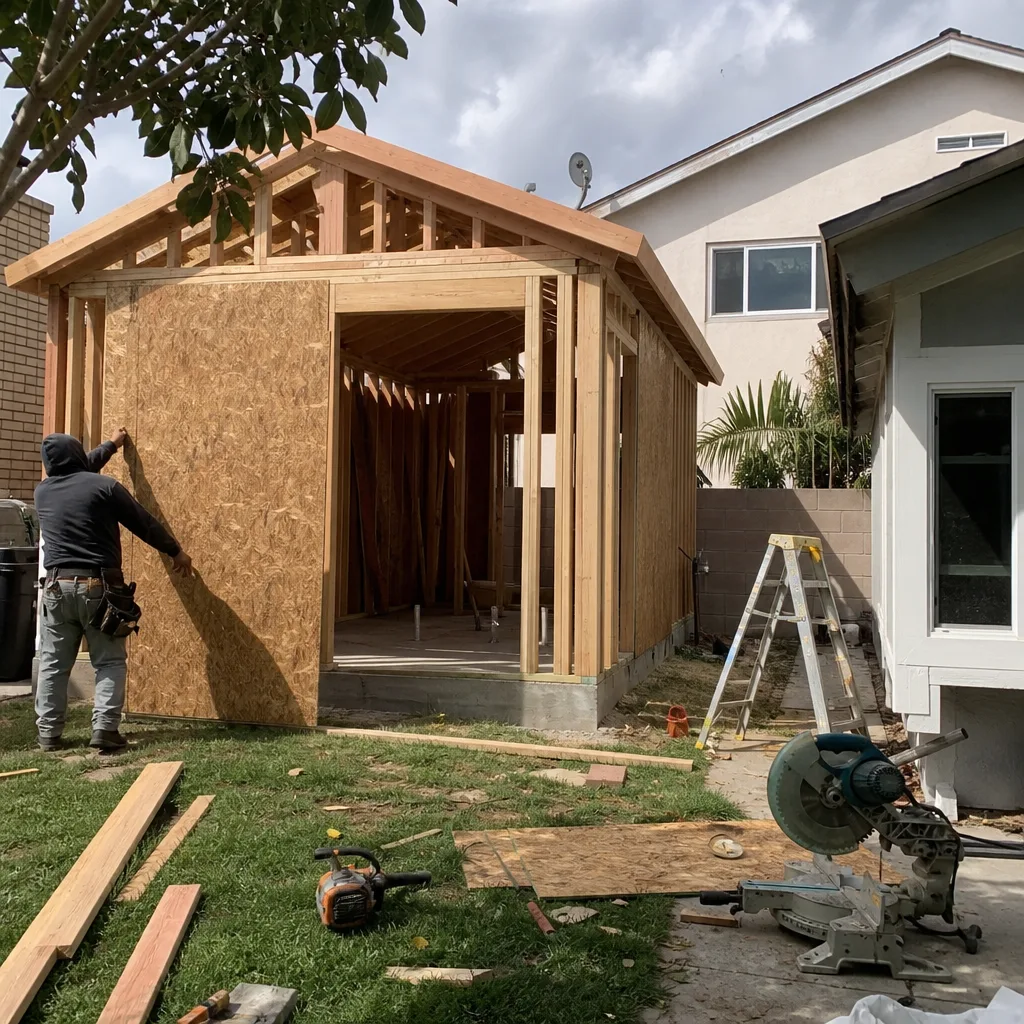
Site-built is conventional stick-frame construction completed entirely on your property. It offers the most design freedom and is typically the right choice for complicated lots: steep grades, tight access, awkward shapes, or existing structures that need to be integrated. The cost per square foot runs higher than factory methods, and the timeline stretches longer, usually 12 to 18 months. For a Tustin homeowner with a standard rectangular backyard and clear side access, site-built is often unnecessary; for a hillside lot in the foothills or an attached addition with structural tie-ins, it’s sometimes the only option that makes sense.
What Shed Conversions Add
A Tuff Shed conversion is technically site-built but starts from a lower-cost shell, which compresses the budget range significantly. A properly permitted shed-to-ADU conversion can work for homeowners who need a compact unit and have a lot where a 10×20 footprint fits without sacrificing yard space. It’s not the right choice for every household, but it’s a legitimate entry point into the ADU market that many generalist contractors won’t mention because the margins are thinner. We include it because a complete guide should cover the full price spectrum honestly.
What an ADU Actually Costs in Tustin
The number most people hear first, some version of “ADUs cost $300 a square foot,” is true only in the way that “houses in Orange County cost $900,000” is true: it hides enormous variation. In Tustin, an ADU project’s cost depends on four things: build method, square footage, site preparation, and finish level. Factory-built ADUs from Abodu or Cover, including delivery, installation, and utility connections, typically land in the $180,000 to $320,000 range for a one-bedroom unit. Site-built custom ADUs run from $300,000 to $450,000 or more for comparable square footage, with the premium reflecting labor, weather delays, and full design freedom. A Tuff Shed conversion, when feasible, can start around $80,000 to $130,000 after insulation, plumbing, electrical, and finishing work.
| Cost Factor | Prefab/Modular | Site-Built | Shed Conversion |
|---|---|---|---|
| Typical range (1 bed, ~500 sq ft) | $180,000 – $320,000 | $300,000 – $450,000+ | $80,000 – $130,000 |
| Design flexibility | Limited to manufacturer options | Full custom | High but size-constrained |
| Typical timeline (after permits) | 4-8 months | 12-18 months | 6-10 months |
| Best for | Standard lots, clear access | Complex lots, custom needs | Small budgets, compact units |
Site work often surprises Tustin homeowners because it’s invisible in marketing materials. Trenching for utilities can cost $8,000 to $15,000 depending on distance from the main line. Upgrading an electrical panel runs $3,000 to $6,000. If your sewer or water lines need repair or replacement during the project, add another $5,000 to $20,000 depending on what the contractor finds. A lot that looks straightforward above ground may sit on top of aging infrastructure below it, and that’s true across much of Tustin’s housing stock, where homes built in the 1960s and 1970s share aging utility corridors.
Tustin Permitting: What the Process Really Looks Like
California law requires that cities approve or deny ADU permit applications within 60 days of submission, but that clock doesn’t start until the application is complete, and getting to “complete” is often where months disappear. Tustin’s Building Division reviews ADU plans for compliance with state ADU law, local zoning, and building codes including energy standards and, for some properties, fire safety requirements in hillside areas. The city’s planning and building departments generally process standard ADU applications efficiently, with many projects completing review within 4 to 8 months from first submission to issued permit, but that assumes a clean application.
- Pre-submittal research: confirm your lot’s zoning, any HOA restrictions if applicable, and where your utility lines run. This step is free but often skipped.
- Site survey: a licensed surveyor maps your property, easements, and existing structures. Budget $2,000 to $4,000.
- Design and engineering: your ADU plans are prepared and stamped by a California-licensed engineer or architect. For prefab units, the manufacturer provides this.
- Permit application submission: plans, calculations, and site information go to Tustin’s Building Division for review.
- Plan review and revisions: reviewers may request corrections. Each round adds time. Resubmission is normal.
- Permit issuance: once approved, you pay fees and receive your permit. Tustin ADU permit fees typically run $8,000 to $15,000 depending on project scope.
- Construction and inspections: your contractor builds to the approved plans, with scheduled inspections at foundation, framing, rough-in, and final stages.
- Certificate of occupancy: the final step, issued after all inspections pass. Your ADU is now legally rentable.
Tustin historically did not have its own ADU-specific fee structure, but state law caps certain impact fees for ADUs under 750 square feet, which has reduced cost barriers for smaller units. We recommend confirming current fee schedules with the city before budgeting, because fee structures change and assumptions from two years ago may no longer hold.
The Manufacturer Landscape: Abodu, Cover, Dvele, and Others
Homeowners who start by researching ADU brands often end up more confused than when they started. The reason is that most sources are dealer-adjacent: a blog written by an Abodu sales partner will naturally frame Abodu as the best solution. The truth is that each manufacturer has real strengths and real limitations, and the right fit depends on your lot and goals.
Abodu is known for speed: units are designed and permitted quickly, with predictable pricing and a streamlined process. Their units are a common choice on standard Orange County lots with clear rear access. Cover emphasizes precision-built panels delivered and assembled on-site, which serves tighter lots where a full module delivery isn’t feasible. Dvele positions at the high end, with a focus on energy performance and build quality that appeals to homeowners in older Tustin neighborhoods who want the ADU to both match and outperform the main house. Boxabl and Plant Prefab round out the landscape with distinct approaches: Boxabl’s compact foldable units target affordability and quick installation, while Plant Prefab focuses on sustainable materials and signature architecture.
What this means for a Tustin homeowner: there is no single best brand. There is a best brand for your access width, your setback conditions, your budget ceiling, and your design tolerance. The honest approach is brand-agnostic sourcing, which is how we operate through our our ADU Builders services: you tell us your lot and goals, we match you to the manufacturers whose constraints actually fit.
Site Conditions That Drive ADU Costs in Tustin
Tustin’s geography creates specific conditions that affect ADU feasibility and cost in ways a generic guide won’t tell you. The city spans flat valley floor and gradual foothills, with older neighborhoods in the central and western areas and newer development in the eastern and southern edges. Each zone has its own ADU profile.
- Access width: Many Tustin homes, particularly older ones on 6,000 square foot lots, have side yard access under 10 feet wide. Prefab modules often require 12 feet or more of clearance for crane placement. If your access is tight, modular or site-built becomes the default.
- Utility line depth and location: Older Tustin homes may have sewer lines running through the backyard where the ADU foundation needs to go, or shallow utility easements that require relocation or foundation adjustments.
- Clay soil and drainage: Orange County’s clay-heavy soils affect foundation design and drainage. Proper grading and drainage planning are essential to prevent water pooling against the ADU foundation during winter rains.
- Mature trees: Tustin has a significant tree canopy in older neighborhoods. Root zones can drive foundation setbacks or require root protection measures, adding cost and potentially shrinking your buildable area.
- HOA overlays: Some Tustin communities have HOAs with CC&Rs written before state ADU law. While state law generally preempts HOA restrictions on ADUs, covenants can still create friction that slows the process.
One of the most common scenarios we encounter in Tustin: a homeowner with a perfectly flat backyard and a detached garage they never use, assuming a garage conversion is the simplest path. Then the structural evaluation reveals the garage slab is not up to residential foundation standards, the roof framing is undersized, and the electrical service is decades out of date. The conversion is still viable, but the cost often approaches that of a new prefab unit, which resets the entire comparison. A detailed site assessment early in the process prevents this kind of mid-project surprise.
The Finishing Phase: Why ADU Interiors Get Skipped
There is a gap between a building being built and a home being finished. Prefab and modular ADU manufacturers deliver a completed shell, and many include basic interior finishes, but the level of finish varies widely between brands and models. What usually remains after the ADU arrives: flooring upgrades, custom cabinetry, bathroom tile work, and kitchen fit-outs that match the main house. This is where many projects stall, because the general contractor who managed the ADU installation may not have the interior finishing capability you need.
For a Tustin homeowner building a rental unit, the interior finish is what determines your rental rate. A builder-grade kitchen and basic bath might rent for $1,800 a month in Tustin’s market. The same unit with a thoughtfully designed kitchen, quality counters, and a finished bathroom could command $2,200 or more. The difference compounds over years and directly affects your payback period. For a multigenerational living setup, the interior quality is the difference between a space that feels like a house and one that feels like a converted shed.
This is why Holloway ADU Builders handles bathroom and kitchen remodeling as part of the ADU scope. The same team that manages foundation and framing also manages tile, cabinetry, and fixtures. You don’t hand off the project to a second contractor who wasn’t part of the original planning. For exteriors, we routinely specify James Hardie fiber cement products, particularly when the ADU needs to match an existing home’s aesthetic. Hardie’s material holds up to Tustin’s dry summer heat and wet winters better than vinyl, and it accepts paint in a wider range of finishes than stucco alternatives. These are the details that make an ADU feel intentional rather than bolted-on.
Common Mistakes to Avoid
- Locking into one brand before understanding your lot. Abodu makes excellent units, but if your side access is 8 feet wide, you’re priced into a site-built solution and the Abodu conversation wasted weeks.
- Budgeting only for construction, not site work. Trenching, electrical panel upgrades, and foundation adjustments routinely add $20,000 to $40,000 to a project. An honest budget includes them.
- Assuming a garage conversion is cheaper without a structural evaluation. In many Tustin homes built before 1980, the garage slab and framing need significant work to meet residential standards, erasing much of the savings.
- Ignoring drainage during the planning phase. A poorly graded ADU site leads to water intrusion problems that are expensive to fix after the unit is installed. Drainage planning belongs in the permit drawings, not after the first winter rain.
- Choosing a contractor without ADU-specific experience. ADUs have their own code chapter, their own fee structures, and their own pitfalls. A generalist remodeler learning on your project is a timeline risk.
- Skipping the interior finish conversation until the shell is up. The rental or family-living value of your ADU lives in the kitchen and bathroom. Planning those spaces during design, not after delivery, is the only way to get a coherent result.
- Underestimating HOA friction time. Even when state law is on your side, CC&R review and HOA communication can add weeks. Starting early costs nothing. Starting late costs a construction window.
When to Call a Professional
If you’re reading this and know your lot has tight access, you have an older home with uncertain utility conditions, or you simply don’t want to spend three months comparing brands and code sections yourself, that’s the moment to bring in a specialist. The patterns that determine ADU feasibility in Tustin aren’t documented anywhere in a single place; they live in accumulated project experience across hundreds of lots and dozens of manufacturers, though you can find more guides & resources on our blog. Holloway ADU Builders offers free estimates in Tustin, and we start every conversation the same way: we look at your lot, we talk about your goals, and we match you to the build method and manufacturer that actually fit. Call (855) 617-6356 to schedule yours. There’s no pitch beyond that.
Frequently Asked Questions
A Tustin ADU typically costs between $180,000 and $420,000 depending on build method, site conditions, and finish level. Prefab units start around $180,000 to $320,000, site-built runs $300,000 to $450,000, and shed conversions can start as low as $80,000. Call (855) 617-6356 for a specific quote on your lot, estimates are free.
From signed contract to move-in, a prefab ADU typically takes 4 to 8 months after permits are issued, a modular unit similar, and a site-built unit 12 to 18 months. Permitting itself usually runs 4 to 8 months in Tustin for a clean application. The total timeline for most projects lands between 8 and 20 months depending on method.
Yes, garage conversions are permitted in Tustin and are a common way to add a rental unit or multigenerational space. The key question is structural: older garages often need foundation and framing upgrades that shift the cost calculation. Get a structural evaluation before budgeting.
Yes. Every ADU in Tustin requires a building permit, and most require planning review. Unpermitted ADUs cannot be legally rented and create liability and resale problems when you sell the property. The permitting process is manageable with the right preparation.
Yes. Once your ADU has a certificate of occupancy, you can rent it as a long-term rental. Short-term rentals under 30 days face additional restrictions in Tustin and Orange County generally, so confirm current rules with the city if that’s your goal.
Prefab ADUs are delivered as complete modules and installed on a prepared foundation in a matter of days. Modular ADUs use factory-built components assembled on-site, offering more layout flexibility. Prefab is faster; modular is more customizable. Both are faster than site-built construction.
The Bottom Line
A Tustin ADU is achievable for most single-family homeowners, but the path is different for every lot. The build method that saves you money on a standard flat lot in a 1970s tract home may not work at all on a hillside property with 8-foot access. The cost range spans $80,000 for a shed conversion to $450,000 or more for custom site-built, and the honest number for your project depends on utility conditions, soil, access, and finishes. What protects you through all of it is real optionality: the ability to compare prefab, modular, site-built, and conversion options against the same lot and the same goals. Holloway ADU Builders works with leading manufacturers including Abodu, Cover, and Dvele, handles Tuff Shed conversions, and manages the interior finishing that turns a delivered structure into a livable home. If you’re exploring an ADU in Tustin, start with a site conversation, not a brand pitch. For more on how we approach ADU construction across the region, see our ADU Builders in Home Gardens guide, or explore how our interior finishing supports ADU projects through Bathroom Remodeling in Home Gardens and Kitchen Remodeling in Home Gardens. You can also learn more about our approach on the Holloway ADU Builders home page.
Written by the team at Holloway ADU Builders, serving Tustin since 2016.