
Last updated October 31, 2026
DIY vs Professional ADU: The Tustin Homeowner’s Decision Guide
California’s owner-builder permit allows more than most homeowners assume, but less than most YouTube ADU channels imply, and the gap between those two facts is where projects get stalled. In Tustin, the question isn’t really whether you can swing a hammer. It’s whether you can produce the structural calculations, energy compliance documentation, and inspection-ready work that the city’s plan check process actually demands. This guide walks through the legal scope of DIY ADU work in California, what Tustin specifically asks for, where owner-builders typically run into trouble, and how to think about the hybrid approach that many successful DIY-minded homeowners end up using. For how to hire an ADU contractor in Tustin: a step-by-step guide, see our companion resource. We’ll also cover the cost math that most online calculators conveniently leave out.
Quick Answer
For most Tustin homeowners, a full DIY ADU is legally possible only if you occupy the property and obtain an owner-builder permit, but self-performing electrical, plumbing, and HVAC work is restricted, and plan check documentation requirements in Tustin make professional drawings and calculations nearly unavoidable. The realistic middle ground is a hybrid: you act as owner-builder, hire a professional for plans, structural engineering, and the trades that require licensed pros, then self-perform finish work like flooring, painting, and trim. Pure DIY on a structure this size typically costs more in time, corrections, and resale friction than the labor savings justify.
Table of Contents
- What California Law Actually Allows for Owner-Builders
- The Tustin Plan Check Reality: What the City Wants to See
- Inspection-Flagged Errors vs. Defects You Won’t See for Years
- The Real Cost of Owner-Managed ADUs in Tustin
- How an Owner-Built ADU Affects Resale and Title Insurance
- The Hybrid Approach: What Smart Owner-Builders Actually Do
- Common Mistakes to Avoid
- When to Call a Professional
- Frequently Asked Questions
What California Law Actually Allows for Owner-Builders
California’s owner-builder exemption, codified in Business and Professions Code section 7044, lets a homeowner act as their own general contractor on their own residence without holding a contractor’s license. That’s the broad stroke. The fine print is where Tustin homeowners get tripped up. The exemption applies to the person who owns the property and intends to occupy or use the structure. It does not extend to investment properties you plan to rent out immediately as the owner-builder, and it definitely does not extend to a friend or relative who happens to be handy. The person who pulls the owner-builder permit is the person who is legally on the hook for the work.
The second layer is trade-specific. While the owner-builder permit lets you act as general contractor, it does not grant you a license to perform electrical, plumbing, or HVAC work that California requires to be done by licensed tradespeople. You can legally paint, install flooring, hang drywall, set cabinets, run trim, and do a range of finish carpentry. You cannot legally wire a subpanel, install a water heater’s gas line, or run new drain lines unless you happen to personally hold the relevant C-10, C-36, or C-20 license. In practice, some owner-builders do this work anyway and hope the inspector doesn’t ask. In Tustin, the inspectors ask. And when unpermitted trade work is discovered, the correction process adds weeks and thousands of dollars to the project.
There’s also the matter of workers’ compensation. When you hire subcontractors under an owner-builder permit, you become the employer of record for purposes of California workers’ comp law. If a worker gets hurt on your Tustin property project and the sub you hired doesn’t have their own workers’ comp coverage, you’re personally exposed. Licensed contractors carry their own coverage and liability insurance. That distinction alone quietly pushes many homeowners toward professional management once they understand the stakes.
The Tustin Plan Check Reality: What the City Wants to See
Tustin’s building department reviews ADU applications through the lens of the California Residential Code, the city’s local amendments, and increasingly, the energy code known as Title 24, Part 6. Keeping up with these evolving standards is part of seasonal ADU care for Tustin homeowners. The plan check is not a formality. ADU submittals in Tustin typically require architectural drawings, structural calculations signed by a California-licensed engineer, Title 24 energy compliance documentation, site plans showing setbacks, and in many cases, a soils report. An owner-builder who thinks they can sketch floor plans on graph paper will have the application returned for resubmittal.
What this means practically is that even the most committed DIY homeowner in Tustin is going to pay a professional for plans and engineering. You cannot self-perform the structural calculations unless you hold a civil or structural engineering license. You cannot self-certify Title 24 compliance without the approved software and credentialing. The parts of the project that are truly DIY in the document phase are limited to things like selecting finishes, reviewing design options, and project managing the paperwork. The document barrier is one reason we see so many Tustin homeowners choose a hybrid model: they own the decisions, but professionals own the drawings.
City response times also shape the DIY equation. Tustin’s plan check turnaround for ADUs has been improving since the state’s ADU streamlining laws, but resubmittals still reset the clock. A professional who has gone through Tustin’s ADU plan check before knows what the plan reviewer will flag: eave height interpretations, firewall ratings on the property line, electrical panel load calculations, and landscape requirements if you’re converting a garage. An owner-builder learns these things one correction letter at a time, and every correction is a delay. That delay has a carrying cost, especially if you’re paying a mortgage on the property while waiting.
Inspection-Flagged Errors vs. Defects You Won’t See for Years
If you strip the DIY ADU decision down to its informational core, it’s this: some mistakes are caught immediately at inspection, and some are invisible for years. The first category is manageable. The second category is expensive. Tustin’s inspectors catch obvious problems during the required inspections at foundation, framing, rough electrical, rough plumbing, insulation, and final. A misaligned shear wall hold-down gets flagged. An electrical rough-in without the proper AFCI breakers gets flagged. Insulation that doesn’t meet the R-value shown on the approved plans gets flagged. These corrections cost money, but they happen before the drywall goes up, which means the fix is accessible.
The invisible defects are the ones that scare us as professionals. An improperly flashed window might pass final inspection and leak slowly for five years, rotting the wall sheathing behind the siding. A shower pan that wasn’t water-tested properly can fail after the warranty period and destroy a subfloor. Ductwork that’s slightly undersized or poorly sealed won’t trip an inspection but will make the ADU uncomfortable for its entire lifespan. A pier footing that’s under-compacted but not visibly wrong at inspection can settle unevenly and crack the slab years later. These are the costs that never show up in the DIY savings calculation.
In fairness, professional work has failures too. The difference is that a licensed contractor is obligated by California law to stand behind their work through the implied warranty of habitability, and their liability insurance gives you a path to recovery. An owner-builder’s recourse when their own work fails is to pay for the repair themselves. When you bought the materials and did the labor, there’s no one else to write the check. That’s the risk tolerance question at the heart of the DIY decision in Tustin.
The Real Cost of Owner-Managed ADUs in Tustin
Most DIY ADU cost discussions start and end with labor savings. That’s the wrong frame. A more honest accounting includes six categories: design and engineering costs, permit fees, materials, subcontractor labor, your own labor hours, and the carrying cost of time. In Tustin, where a detached ADU project of 600 to 800 square feet typically runs $250,000 to $400,000 when professionally built, the line-item labor for a general contractor’s management might represent $30,000 to $50,000 of the total. That’s the number that tempts homeowners to go owner-builder.
But subtract from that the design and engineering costs, which you pay either way and which run $8,000 to $20,000 depending on ADU type and site conditions. Subtract the permits, which run several thousand dollars in Tustin depending on project size and school fees. Subtract the licensed subcontractors for electrical, plumbing, and HVAC, which a legal owner-builder hires rather than self-performs and which total $20,000 to $40,000 on a typical project. What’s left of the contractor management fee after direct costs is maybe $10,000 to $20,000. That’s the actual amount you might save by managing the project yourself. Now ask what your hourly rate is, because an owner-managed ADU in Tustin typically consumes 400 to 800 hours of your time across plan check, bidding, scheduling, sourcing materials, and on-site coordination.
Then add the time factor. A professionally managed ADU in Tustin takes roughly 12 to 16 months from design to final inspection, sometimes longer depending on the build method. An owner-managed project frequently stretches to 18 to 24 months because the homeowner doesn’t have established relationships with the subs who are also juggling larger jobs. Every month of delay is a month you’re not collecting rent or housing your in-laws. At a conservative Tustin ADU rental rate of $2,000 to $2,500 per month, six extra months of delay is $12,000 to $15,000 of lost income. That’s most of your labor savings right there, before you’ve accounted for the cost of your own hours.
How an Owner-Built ADU Affects Resale and Title Insurance
This is the section most guides skip, and it’s one of the most consequential for Tustin homeowners. When you sell a property with an ADU, the buyer’s title insurer runs a permit history search. They’re looking for open permits, expired permits, and unpermitted work. An ADU built under an owner-builder permit with all final inspections signed off is a clean title item. An ADU with an open owner-builder permit that was never finalized is a title defect, and buyers’ lenders will not fund until the permit is closed.
There’s a second disclosure layer. California’s Transfer Disclosure Statement asks the seller to disclose any work done without permits or any known defects. If you owner-built the ADU and later discover that the shower leaked or the electrical panel was marginal, you have a duty to disclose it if it’s material. A buyer who discovers undisclosed defects can pursue you after the sale. That’s true of any seller, but it bites owner-builders harder because there’s no contractor insurance policy standing between you and the demand letter.
Title insurance companies also scrutinize owner-builder work more closely because there’s no licensed contractor’s record to anchor the chain of responsibility. Some policy underwriters require a retrofit structural inspection before they’ll write title on a property with an owner-built ADU. That inspection is paid for by the seller and can surface problems at the worst possible moment, in escrow, when you have the least leverage. A professionally built ADU with a contractor’s permit history and signed inspection cards produces none of this friction. That resale clarity is worth money, and it’s a line-item the DIY calculation usually misses entirely.
The Hybrid Approach: What Smart Owner-Builders Actually Do
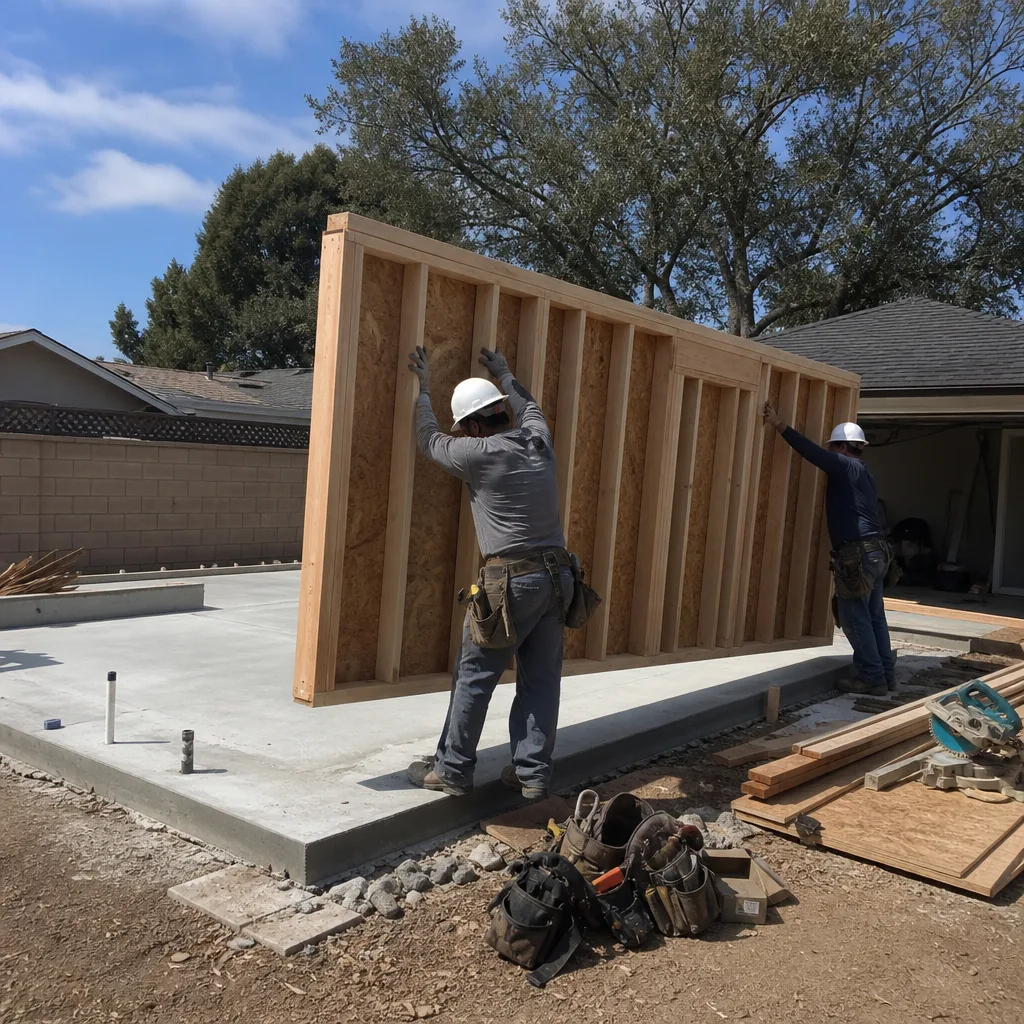
After watching years of ADU projects move through Tustin, we’ve concluded that the homeowners who are happiest with the DIY decision rarely choose pure DIY. Following a structured ADU builders maintenance checklist for Tustin homeowners helps keep these hybrid projects on track long-term. They choose a structured hybrid. They pull the owner-builder permit and take on the general contractor role, which is legal and keeps them in control of decisions and scheduling. Then they subcontract the work that requires licenses or specialized tooling, hire a professional designer or ADU specialist for the plans, and reserve for themselves the finish work where mistakes are easily corrected and the schedule impact is low.
The finish work that makes sense to self-perform in a Tustin ADU includes interior painting, flooring installation if you have experience, bathroom and kitchen fixture trim, door hardware, closet systems, and landscaping around the structure. These scopes don’t require a license, don’t carry the same injury liability as roofing or electrical, and mistakes don’t hide structural problems. They’re also the scopes where homeowner labor genuinely moves the budget, because finish carpentry and paint labor from a professional can run $15,000 to $25,000 on a full ADU.
The scopes you should never self-perform, legally and practically, include structural framing beyond simple non-bearing partitions, any electrical work beyond swapping a fixture, any plumbing beyond changing a faucet, any gas work at all, roof installation and flashing, and anything involving scaffolding over six feet. Hire licensed trades for those. In Tustin, the inspectors know which permits go with which licenses, and they’ll ask to see them. A professionally structured hybrid keeps you inside the law, preserves the labor savings that actually exist, and produces a structure with a clean permit history. If you’re weighing brand-built approaches like Holloway ADU Builders home options for prefab or modular units, the hybrid logic shifts: the manufacturer handles the complex factory work, and the site work is smaller by definition, which changes the DIY calculus again. A few of the brands we work with, such as Boxabl and Plant Prefab, are designed around compressing on-site labor, which directly shrinks the owner-builder coordination burden.
Common Mistakes to Avoid
- Pulling an owner-builder permit for a property you don’t occupy. California’s exemption requires owner occupancy. Building an ADU as owner-builder on a rental property you don’t live in violates the exemption and can invalidate the permit.
- Sketching plans instead of hiring a designer. Tustin plan check will reject hand-drawn or non-compliant drawings, and every resubmittal costs weeks. Budget for professional plans and engineering from day one.
- Self-performing electrical work. Even if you’re capable, the legal exposure and inspection risk aren’t worth it. A failed Tustin electrical inspection on owner-builder work triggers a correction cycle that’s hard to close without a licensed electrician called in mid-project.
- Underestimating the coordination hours. The general contractor’s fee isn’t just overhead. It’s the cost of knowing which subs show up in what order, who to call when the concrete pump cancels, and how to keep the inspection queue moving.
- Forgetting about workers’ comp liability. If a sub you hire on an owner-builder permit gets hurt and doesn’t carry comp, you’re the employer of record. Confirm coverage in writing before anyone steps on site.
- Skipping the pre-drywall photo documentation. Before the walls close, photograph every wall cavity, every plumbing run, every electrical rough-in. If a future buyer or inspector asks what’s inside the walls, the difference between documented and undocumented is weeks of tear-out.
- Treating the ADU permit as a weekend project. Tustin’s permit process rewards consistency. A three-month gap where you stop responding to plan check comments or stop scheduling inspections can trigger permit expiration complications that are costly to revive.
When to Call a Professional
Call a professional if the property has any site constraint that affects structural design: sloped lots, expansive soils common in parts of Tustin, property line proximity that triggers fire-rated wall requirements, or existing foundations of unknown condition. Call a professional if the ADU needs a new electrical service or panel upgrade, which many Tustin ADUs do when the existing panel is at capacity. Call a professional if you want a realistic project schedule and you’re not willing to spend 20 hours a week managing subs. And call a professional if the thought of negotiating with a plan checker over eave height interpretations makes you want to sell the house. Holloway ADU Builders offers free estimates in Tustin – call (855) 617-6356. We’ll match you to the right ADU approach, prefab, modular, or site-built, based on your lot and goals, and help you sort the DIY scopes from the delegate-to-a-pro scopes.
Frequently Asked Questions
Yes, as an owner-occupant you can pull an owner-builder permit and act as your own general contractor, but California law still requires licensed trades for electrical, plumbing, HVAC, and gas work, and Tustin’s plan check requires professional drawings and engineering. In practice, most successful owner-builders self-perform finish work and subcontract the technical scopes.
The real savings after paying for plans, permits, engineering, and licensed subcontractors typically lands between $10,000 and $20,000 on a full project, which is the general contractor’s management fee after direct costs. That savings is often offset by six to twelve months of project delay and the lost rental income that delay causes at Tustin market rates.
A failed final inspection starts a correction process: the inspector issues a correction notice listing deficiencies, you fix them, and you schedule a reinspection. Each reinspection cycle adds days or weeks, and if the issues are electrical or plumbing, you’ll likely need to bring in a licensed contractor to sign off, which is the exact work you were trying to avoid paying for.
Not necessarily. A completed, permitted, inspection-approved ADU adds value regardless of who built it. What hurts resale is an unfinished project, an open permit, or undisclosed defects that appear in escrow, which is when the buyer has the most leverage to renegotiate or walk.
You can self-perform many finishes, but if you’d rather not, look for a contractor whose scope covers the structure and the interior. ADU Builders in Home Gardens and similar nearby markets often need a Bathroom Remodeling in Home Gardens specialist or a Kitchen Remodeling in Home Gardens contractor, and coordinating two or three companies adds project management overhead. One team from foundation to finished kitchen eliminates that friction.
Prefab and modular units from manufacturers like Boxabl and Plant Prefab compress the on-site construction timeline significantly because most of the structural work happens in a factory. Site preparation and foundation work still occur on your lot, but the framing, electrical rough-in, and finish systems arrive largely complete. That reduces the number of subs you’d manage as an owner-builder and shortens the window where coordination mistakes can stall the project.
For some Tustin lots, yes. A conversion starts with an engineered structure that’s already built, which removes the framing and structural inspection risk from your plate. The remaining work is foundation, utilities, insulation, and interior finish, much of which is manageable on a hybrid owner-builder basis. The permit path still requires Tustin plan check approval and the same utility trades, but the overall project scope and cost are lower than a ground-up build. James Hardie fiber cement siding is a common choice for conversions needing a durable, low-maintenance exterior that ties into the existing home’s look.
The Bottom Line
The DIY vs. professional ADU decision in Tustin isn’t a skill question. It’s a legal scope question, a documentation question, and a risk tolerance question. What California lets owner-builders do is broader than most people think, but narrower than DIY content implies, and Tustin’s plan check process enforces that boundary with real consequences. The homeowners who come out ahead are the ones who treat DIY as a structured hybrid: own the decisions, hire professionals for the technical core, self-perform the finish scopes that actually save money, and protect the resale value with a clean permit file. If you’re weighing the tradeoffs for your specific Tustin lot, a conversation about prefab, modular, site-built, or conversion paths costs nothing and clarifies everything. Explore more guides & resources on our blog or call (855) 617-6356 to schedule your free estimate. Call (855) 617-6356 to schedule your free estimate.
Written by the team at Holloway ADU Builders, serving Tustin since 2016.